Saturday, 2 January 2021

Thinking activity: Puritan and Restorations Age

Puritan age:-

                     Puritan age was begun from 1600 and it ends in 1660. The year 1660 is the beginning of the Restoration period. So before the Restoration period there is the thought of Puritanism among the peoples of England and also among other countries.

So the literature of the 17th century divided into two periods:-


                   The 17th century marked as the decline of the Renaissance spirit and the new writers starts imitating the great writer of Elizabethan era and followed the new paths. Now there is no writer remain who write on the basis of their imagination. The age was dominated by the logic and reasoning. The temperament of the writers was totally changed which was called essentially modern.

                 The 17th century from 1600 to 1660 was dominated by Puritanism and it is called the Puritan age. Because Milton was the nobler representative of the Puritan spirit, so the age was also called as Age of Milton (Neoenglish system, 2010).

                This movement is also considered as the second and greater Renaissance in literature. With the rise of this period the moral or intellectual nature of the man was also rose. It was like the rebirth of the morality among the peoples of the society. The Renaissance which already had a marked quality of its high culture, now needed only the moral sobriety and profundity, which were given by the Puritan movement.

                Unscrupulousness and fanaticism in politics and religion were on rampant during the Renaissance period. Therefore the Puritan movement came and it stood for its liberty and introduced the morality and high ideals in politics. Puritan movement had two objectives:-


                    But soon the Puritans began to look down as narrow-mindedness during the Restoration period. They were against all sort of recreations and amusements, in fact in reality they were not so. Puritans are very much religious in their concept, they didn’t form a separate religious sect.

                  Milton and Cromwell are the two real champions of liberty who stood for toleration against the tyrannical rule of Charles I. It would be wrong if we called them narrow-mined fanatics. Means in reality the high standard of morality leads to them to be trapped in their own world and was unable to think beyond it.

                From very first the name Puritans was given to them who advocate the change in the church of the England during the reign of Queen Elizabeth. But many opposed to this movement including the King Charles I, but soon he was defeated and beheaded in 1649 and the Puritan movement came out triumphantly. Therefore in this way the Puritan movement was more called the National movement of England.

               In literature also there was the same confusion as we found in the field of politics and religion. The literary achievements of this period are not of high order and of greatness but still some of its works recognized as the great work of the writers. The Puritan poetry is further divided into three parts:-


1-The School of Spenser


               Edmund Spenser was the leader of the school of Spenser. There were many followers of Spenser. Spenser and Sidney both made the Italian poetry more fashionable during the 16th century. All the writers of the age make Spenser as their master.

             The two brothers Phineas Fletcher and Giles Fletcher are the most thorough disciples of Spenser during the reign of James I. They were both priests.

            Phineas Fletcher wrote number of Spenserian pastorals and allegories. The Purple Island was his most ambitious poem which portrays the detailed allegory of the physical and mental constitution of men, the struggle between Temperance and his foes, the will of man and Satan.

          Giles Fletcher’s Christ’s Victorie and Triumph in Heaven and Earth over and after Death, is the most famous allegorical narrative which was written in Lyrical strain. As Giles was more Lyrical and mystical than his brother Phineas. This work portrays the Temptation, Crucifixion, and Resurrection of Christ.

William Browne, George Wither and William Drummond are the other poets who wrote under the influence of Spenser.


2-The Poets of the Metaphysical School

John Donne, Herrick, Richard Crashaw, Henry Vaugham, Thomas Carew, George Herbet and Lord Herbert are the metaphysical poets. However the leader of this school was John Donne. The poetry of metaphysical poets is full of conceits, exaggerations, quibbling about the meaning of the words, far-fetched similes, metaphors. The metaphysical poets were honest and they were the original thinkers. They were all aware of the life and have concerned with the death.

John Donne wrote poetry of vey high order. The Progress of the soul; An Anatomy of the World, an elegy; and Epithalamion are his best known works. His poetry was divided under three categories:-

Robert Herrick wrote amorous as well as religious verse.

Thomas Carew was the finest lyric writer of his age. He is superior to Herrick in workmanship. ‘Persuasions of Love’ is a fine piece of work of Thomas Carew.

Richard Crashaw had different temperament than Herrick and Carew. He was very religious poet. ‘The Flaming Heart’ is the best work of Richard.

Henry Vaughan was a mystic like poet. He is more uniform and clear, tranquil and deep than Crashaw.

George Herbert is the most widely read poet of his age. He expressed his thoughts in a clear manner than others. There is also Transparency of his conceits.

Lord Herbert of Cherbury is inferior to his brother in writing verse. He is well known for his autobiographies. He was the first poet who use metre.


3-The Cavalier Poet

Ben Johnson was the leader of the Cavalier poets. Johnson followed the classical methods in his writing. He was influenced by the classical writer like Horace, and others. Ben Johnson’s work, lyrics and songs are different from that of Shakespeare.

The term ‘Cavalier’ means royalist but in real all the Cavaliers are not royalist. There is not much difference between the Cavalier and Metaphysical poets, because some Cavaliers like Carew, Suckling and Lovelace were also the disciples of Donne. Even some poems also have same quality of both Donne and Ben Johnson. But the Cavalier poets wrote on trivial subjects, whereas the metaphysical poets wrote only on serious subjects.

Sir John Suckling is the courtier of Charles I and most of his poems are trivial; written in doggerel verse.

Sir Richard Lovelace was another follower of king Charles I. ‘Lucasta’ is his volume of love lyrics. His poems like “To Lucasta” and “To Althea, from Prison” was very famous in English poetry.

John Milton

Milton was the greatest port of the Puritan age. He was identified as Puritanism. Milton was different from all the poets of his age. Milton was a deeply religious man and was endowed with the artistic merit of high degree. Milton was a great scholar. He was not only the scholar of classics but of Hebrew literature also. He was a great humanist.

The most significant early works of Milton are- The Hymn on the Nativity, Lycidas, Comus.

Lycidas is an elegy written in the country’s churchyard on the death of Milton’s friend.


Conclusion :-


Therefore we can say that during this period English literature developing into a grand iloquent and rich instrument. And it is also capable of expressing the great ideas, scientific, philosophical, religious, poetic and personal.

• The Era of Puritanism (1564-1660): Literary Works

January 05, 2015

The reign of the Puritans also produce a large amount of literature (poetry, prose), but drama could not thrive because it is prohibited by the authorities. Drama regarded as a nest of immorality by the Puritan authorities. It is just so different with Elizabeth period where drama produces a lot of outstanding works. So we can see that the literary works of Puritan period are just different from Elizabeth period. In period of Puritan literature, there are three groups of poems; metaphysical, cavalier and Puritan. Here are the complete version of the era of Puritanism (1564-1660): Literary Works.

Poetry

We can find poems in this period are way too different from the previous one. We may even call the literary in this period as the depression kind of expression. If in Elizabethan period we know some greatest poets like Edmund Spenser, Philip Sidney, George Chapman and Thomas Sackville who each of them expressing their emotions through their works. The emotions here are like the real emotion which a human possessed. Unlike this period, we can find three new kinds of poems which are different with any poem in previous periods. The characteristic of a poem in this period includes a thing, like geometrical, not human being, as the comparison material. This kind of poem can be classified into metaphysical poetry.

Metaphysical Poetry

The term was first used by Dr. Samuel Johnson (1709-1786), a famous writer of the 18th century. Metaphysical poetry prefers intellect rather than emotions, so there are a lot of scientific terms in the poem. There are plenty of prominent metaphysical poets in this period, like John Donne (1572-1631), George Herbert (1539-1633), Edmund Waller (1606-1678), Sir John Suckling (1609-1642), Andrew Marvell (1621-1678), and Henry Vaughan (1621-1695).


Metaphysical poetry has the following characteristics:

1. The poems are always in short version, have solid meanings and very economical in the use of words (concentration).

2. The use of unusual imagination (imaginary or unusual conceit).

3. The use of harsh language and rude (often very strong and rough language).

4. The use of science terms (science and learning).

5. The theme revolves around human nature ambiguous (man's dual nature): physical and spiritual.


John Donne (1572-1631)

He is the first poet of metaphysical poetry who was born and raised in a strong Catholic tradition. He studied in Trinity College, Cambridge and then became a Lincoln’s Inn’s member. He was popular for his lifestyle: read a lot but living lavishly. As a metaphysical poet, he used unusual imaginary and he doesn’t use conventional comparisons, rather uses fantastic metaphors and excessive hyperboles. The Sun Rising, The Good Morrow, Love’s Alchemy, and A Valediction: Forbidding Mourning are some his phenomenal works. As for the latter poem, Donne said that his idea was still telling about a couple, even when one of them is separated. He is so popular in making a lot of poems about love. Here is the uniqueness comparison which he used in one of his metaphysical poems:


Our two souls therefore, which are one

Through I must go, endure not yet

A breach, but an expansion

Like gold to airy thinness beat


If they be two, they two so

As stiff twin compasses are two,

Thy soul the fix foot, makes no show

To move, but death, if th’ other do.


And thought it in the centre sit,

Yet when the other far death ream,

It leans, and hearkens after it,

And grows erect as that comes home.


Such wilt how to be me, who must

Like th’ other foot, obliquely run;

Thy firmness makes my circles just,

And makes me end, where I begun.


We can see that the first stanza states that two souls have become one, then even if one had to go, it will not lead to a split, rather becomes widespread as gold which hammered into as thin as air.For the second stanza, it states that if they become two souls, those souls are like a pair of rigid compasses. The compass’ soul that became permanent leg shows no sign of move, but the legs would move, if the other leg moves.

Fun Facts:

There are also some poets who made religious poems, such as George Herbert, Henry Vaughan, and Abraham Cowley. Here is one of George’s religious poems.


The Pulley (or Rest, or The Gifts of God)


When God at first made man,

Having a glass of blessing standing by,

“Let us,” said He, “pour on him all we can:

Let the world’s riches, which dispersed lie,

Contract into a span”,


So strength first made way;

Then Beauty flowed; then Wisdom; Honour, Pleasure.

When almost all was out, God made a stay,

Perceiving that alone, of all His treasure,

Rest in the bottom lay.

“For if I should,” said He,

“Bestow this jewel also in my creature,

He would adore my gifts instead of me,

And rest in Nature, not the God of Nature;

So both should loser be.


“Yet let him keep the rest,

But keep them with repining restlessness;

Let him be rich and weary, that at least,

If goodness let him not, yet weariness

May toss him to my breast”.


First stanza: When God created the first man, he provided a glass of blessing. God says: I will pour all my power and wealth of the world that had been scattered, so that becomes one (in humans).


Second stanza: And came in the strength, beauty, wisdom, honor, pleasure. When everything is running out, God stopped him because he realizes the language of all his wealth, is safely kept at the bottom (bottom).


Cavalier Poetry


The poets of this kind of poetry are the most loyal followers of King Charles I. They have high-spirited souls which are different with those metaphysical poets. They really love secularism things and not really a fan of religious thing. They imitate a popular motto from Italy, Carpe Diem which means “Catch the Day” or in our current motto, it is like You Only Live Once, so be happy and do whatever you want to do. Make pleasure while you are still alive, because tomorrow you may be dead. Some prominent poets are like Robert Herrick (1591-1674) with some of his works; To the Virgins to Make Much of Time, To Enjoy the Time, and To Daffodils, Thomas Carew (1595-1639) with some of his works; To His Mistress in Absence, and Richard Levelace (1618-1658) with his poems To Althea from Prison. This is one of Cavalier poems, To the Virgins to Make Much of Time from Herrick.


Gather ye rosebuds while you may

Old Time is still a-flying;

And this same flower that smiles today

Tomorrow will be dying.


The glorious lamp of heaven, the sun

The higher he is a-getting,

The sooner will his race be run,

And nearer he is to setting.


That age is best which is the first,

When youth and blood are warmer;

But being spent, the worse and worst

Times still succeed the former.


Then be not cuy, but use your time,

And while ye may, go marry;

For, having lost but once your prime,

You may forever tarry.


First stanza: Gather flowers while you can, because time flies. Flowers that glow today will wither tomorrow morning.


Second stanza: The sun shines like bright lights of heaven. The higher the sun, the closer it will be drowned.


 • Restoration period


The Restoration in England began in 1660 just after the age of Puritans and last long till 1700 (wikipedia, the free encyclopedia, 2017). It took place during the Stuart period, when all the monarchies of English, Scottish and Irish were restored under the Stuart king Charles II. The term Restoration used  to describe the restoration of the monarchy and also the period, when new political settlement was established. In the reign of Charles II, the entire age of Restoration is covered and also half in the reign of his younger brother James II.

Richard Cromwell

Richard Cromwell was unable to proceeds his father’s policies, so English Restoration was not continued. He was the son of Oliver Cromwell. The main weakness of Richard was that he did not have the confidence of the army. The Wallington House party removed him from their group and reinstalled the Rump Parliament. And the commandment was given to Charles Fleetwood.


Charles II hoped that with Spanish support he can wins the battlefield but he was defeated by General Lambert. Lambert was become the major General of all the forces in England and Scotland and Fleetwood being general.


Lambert went with large force to meet George Monck, who was the commander of English forces in Scotland. Into this atmosphere Monk was marched south with his army from Scotland under the Cromwell, but soon Lambert’s army desert him and he returned to London almost alone.

Lambert was sent to the Tower of London, on 3 March 1660, but he escaped from there in month. He was recaptured by Colonel Richard Ingoldsby. Lambert was incarcerated and died in custody on Guernsey in 1694.

Charles II

Charles II made several promises in the Declaration of Breda in relation to the reclamation of the crown of England, on 4 April 1660. It was proclaimed that king Charles II was the lawful monarch since the execution of Charles I. Charles leaves the Hague and returned from exile on 23 May and entered London on 29 May 1660. So therefore to celebrate the return of his majesty, 29 May was made a public Holiday. This day was popularly known as Oak Apple Day. Charles II was crowned at Westminster Abbey at 23 April 1661.

Because of the sudden and unexpected change, some contemporaries called Restoration as a “divinely ordained miracle” or the Restoration of the divinely order. The Cavalier Parliament was established on 25 April and it was also known as Pensionary Parliament because it provides pensions to the adherents for many years. Like its predecessor, it was very much royalist. Edward Hyde was the leading political figure at the beginning of the Restoration. He was the first Earl of Clarendon.

Conclusion

The Glorious Revolution ended the Restoration. The Glorious Revolution which overthrew King James ll of England was propelled by a union of English Parliamentarians with the Dutch stadtholder. 

William III was also known as Prince of orange. He organize a meeting to handle the current situation of England in a Convention Parliament. The Parliament members decide that to fill the vacancy of throne James’s daughter Mary has to rule jointly with her husband William. The Bill of rights was passed by English Parliament in 1689 that denounced James for abusing his power. There is also srict order was passed against the Roman Catholics. No Roman Catholics has rights to ascend the English throne and nor any English monarch permitted to marry a Roman Catholic.

Hence it was an end of the Restoration period with the Glorious victory of William III.

• Restoration period literary works :-

Poetry

The Restoration was an age of poetry. Not only was poetry the most popular form of literature, but it was also the most significant form of literature, as poems affected political events and immediately reflected the times. It was, to its own people, an age dominated only by the king, and not by any single genius. Throughout the period, the lyric, ariel, historical, and epic poem were being developed.
 
Prose

Prose in the Restoration period is dominated by Christian religious writing, but the Restoration also saw the beginnings of two genres that would dominate later periods: fiction and journalism. Religious writing often strayed into political and economic writing, just as political and economic writing implied or directly addressed religion.
 
Theatre

The return of the stage-struck Charles II to power in 1660 was a major event in English theatre history. As soon as the previous Puritan regime’s ban on public stage representations was lifted, the drama recreated itself quickly and abundantly. Two theatre companies, the King’s and the Duke’s Company, were established in London, with two luxurious playhouses built to designs by Christopher Wren and fitted with moveable scenery and thunder and lightning machines.
Traditionally, Restoration plays have been studied by genre rather than chronology, more or less as if they were all contemporary, but scholars today insist on the rapid evolvement of drama in the period and on the importance of social and political factors affecting it. (Unless otherwise indicated, the account below is based on Hume’s influential Development of English Drama in the Late Seventeenth Century, 1976.) The influence of theatre company competition and playhouse economics is also acknowledged, as is the significance of the appearance of the first professional actresses.

Literary characteristics of puritan Age

Genres

2. Reatoration age


Restoration Literature Characteristics

Comedy of Manners

  • The Comedy of Manners is a theatrical genre that was uber-popular during the Restoration period. These comedies were bawdy and dirty, with lots of hilarious (and scandalous) dialogue focusing on sex. Their plot lines revolved around unfaithful wives, cuckolded husbands, and tricky lovers.

    These comedies made fun of people… and sometimes entire social classes. Everyone is made to look ridiculous in these plays. People are stupid and gullible, or else they're amoral and exploitative. But it was all done in the name of fun. Audiences went to these plays during the Restoration period to laugh their heads off

  • Satire

    The Restoration writers couldn't get enough satire. What's the deal with satire? Satire is when we joke or exaggerate in order to point up someone else's flaws. Think John Oliver's Last Week Tonight. Think The Onion. Think generally snarky hilarity.

    The Restoration writers developed satire as a genre and a style of writing. These authors loved picking on people—literary rivals, religious figures, even entire social classes—and showing just how ridiculous they all were. Restoration writers mastered the art of poking fun at people.

    Heroic Couplet

  • A heroic couplet is two lines of verse (in ten syllables each), which rhyme. It does not, however, contrary to popular belief, rescue puppies from burning buildings, help old ladies across streets, or untie damsels in distress from railroad tracks.

  • History time: The Heroic Couplet in English literature was pioneered by Geoffrey Chaucer in the Middle Ages, but it wasn't until the Restoration came along that the use of this structure in English poetry became widespread. And that was thanks to one man: John Dryden. Dryden was so good at coming up with Heroic Couplets, he singlehandedly helped make them an essential part of English poetry. He's the hero of the Heroic Couplet.

Social Life

The Restoration writers weren't interested in silly things like nature (ew, dirt), or grand philosophical questions (ugh, boring). They were interested in all the drama that went on in the society in which they lived. Social behavior and social manners, then, are big themes in Restoration literature.

The writers of this period were obsessed with social life: who people fall in love with, who they want to marry, who they sleep with, who they betray, and how much money they have or don't have. It's a literature that focuses on the intrigue that takes place in drawing rooms, in salons, and in—bow chicka bow bow—bedrooms.

Politics

The "Restoration" in Restoration literature comes from a political event (the restoration of monarchy in Britain in 1660) so it's no huge surprise that politics, and political themes, are kind of a big deal in this literary movement.

Restoration literature raises big ol' political questions like: What type of government is best for society? What role does government, or monarchy, play in people's lives? What kind of allegiance do we owe to our government? How does politics shape culture? The Restoration period was a time when Britain was seriously re-thinking its political identity. And we'll find that the Restoration writers were also thinking pretty hard about politics in their writing.

Pepys's Diary

Pepys began life in a small way as a clerk in a government office, but soon rose by his diligence and industry to be Secretary of the Admiralty. Here he was brought into contact with every grade of society, from the king's ministers to the poor sailors of the fleet. Being inquisitive as a blue jay, he investigated the rumors and gossip of the court, as well as the small affairs of his neighbors, and wrote them all down in his diary with evident interest. But because he chattered most freely, and told his little book a great many secrets which it were not well for the world to know, he concealed everything in shorthand,--and here again he was like the blue jay, which carries off and hides every bright trinket it discovers. The Diary covers the years from 1660 to 1669, and gossips about everything, from his own position and duties at the office, his dress and kitchen and cook and children, to the great political intrigues of office and the scandals of high society. No other such minute-picture of the daily life of an age has been written. Yet for a century and a half it remained entirely unknown, and not until 1825 was Pepys's shorthand deciphered and published. Since then it has been widely read, and is still one of the most interesting examples of diary writing that we possess. Following are a few extracts,[181] covering only a few days in April, 1663, from which one may infer the minute and interesting character of the work that this clerk, politician, president of the Royal Society, and general busybody wrote to please himself

4,806 words 29,122 characters

Sunday, 13 December 2020

Thinking Activity : Macbeth

Macbeth

1.Film adaptions :-

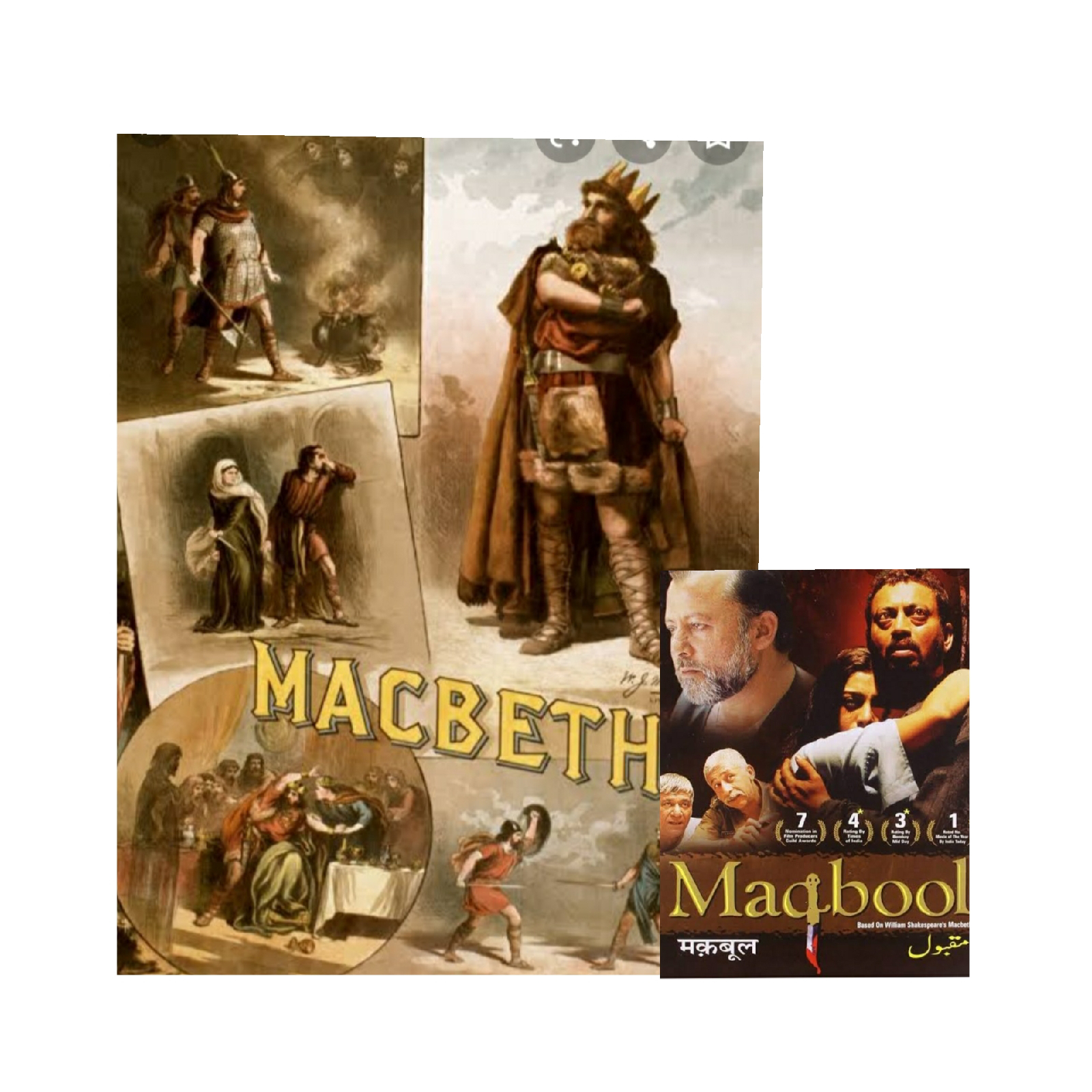
Comparison of William Shakespeare’s Macbeth to Vishal Bharadwaj’s Maqbool:
    
                       The term adaptation itself states that getting into the skin of the work or getting the fundamental idea that the written piece of work tries to present. When adapting a story the essence of the story is woven into the very treatment of the film. There is no clear way of defining how to conceive an adaptation or how to address the contextual problem that occurs during scripting the film. One basic issue that happens with adaptation in contemporary themes is how much can be changed from the actual text and fabric of the story keeping the sublime idea of the novel intact. Some changes are inevitable, like the geographical change, social structure, the time of work, etc. They will have some effect on the quality of the work. Another aspect is the length of the film. Since film is a time bound medium many a times some aspects of the written text are not included in the script. 
                             
                       His first adaptation i.e. Shakespeare’ Macbeth in a gangster based film named “Maqbool”. Vishal accidentally came across an abridged version of Macbeth and connected the basic central theme of ambition and guilt to a contemporary gangster plot. Though the film was not a great commercial success but it was critically appreciated and ushered a new way of adaptation film in contemporary Indian cinema. For the purpose of this study, the adaption can be compared with the text under three broad 

Categories :- 

    1. Plot
    2.Characters
    3. Context 

1. Plot :-
 
                        The plot of Macbeth is set in the Elizabethan age displaying aristocracy of Scotland. The story revolves around treachery of a valiant general Macbeth who became a victim of his ambitions. Although an honest kinsmen initially, Macbeth met three Witch sisters on his way back from a battle. The witches’ prophesized that he would be honored with the Thane of Cawdor and Glamis adding that he would one day become the king himself. The prophecies meddled with his naïve self, gave him a hope that he might actually become king one day. Macbeth meets the criterion of a Shakespearean tragic hero. There is a school of thought in Literature which argues that the defeat of Macbeth was his own doing. Although he had people around him who were influencing him but he took the final call. He murdered the king of Scotland (Duncan), for Macbeth wanted to become the King himself, an ambition short lived. 
                  
                         Maqbool on the other hand is set in the backdrop of Mumbai underworld with a Mafia Jahangir Khan replacing the King of Scotland Duncan and Maqbool playing his right hand (instead of General in the army). Maqbool remains a close confidante of Jahangir initially. The witch sisters are replaced by the corrupt inspectors in the film. It was the astrological prediction of the inspectors that led Maqbool to believe that he could one day take over Jahangir Khan. The switch from Scottish aristocracy to underworld mafia of Mumbai could be attributed to the contexts in which the play and the film are based. Variety wrote that while the visuals are great, audiences might need an understanding of Macbeth to fully enjoy the film Whereas Macbeth was composed by Shakespeare around 1600s when aristocracy was prevalent in Scotland, Maqbool was made much later in the 2003 in India. Creating a period drama is one thing, but creating one with a different context altogether is a gamble; reason being, the limited understanding of the audience of the culture of Elizabethan age and the aristocratic gesturesand symbols. The easier and safer way for the director remains to customize the context so that majority of the audience could relate with it. Outlook said that it (Maqbool) "effectively transported the essence of the story to the milieu of the Bombay underworld of our times" 


2. Characters :-
   
                      Vishal Bharadwaj as an auteur has taken full liberty with the context as well as the characters of Maqbool. The major characters remain the same except for some of their associations; for instance, the witches are replaced by the corrupt policemen duo. Upon close observation, one can see that the policemen (played by Naseeruddin Shah and Om Puri) are not completely negative in character as against the witches who actually had evil motives. They have an important role to play in the ‘balance of power’ in the entire plot. In Macbeth, the character of Duncan is positive and his assassination is tragic; it’s a crime for which the Lady Macbeth summons evil forces. But the mafia in Maqbool (Jahangir Khan) is shady himself. He is into contract killings, housing scams and is also suspected to have killed his own Godfather treacherously. So his death is not taken as negatively as Duncan’s. Although Maqbool feels the guilt of killing his Godfather in cold blood, taking over Jahangir’s kingdom as well as mistress (the love interest of Maqbool). A major deviation in the characters can be traced in the role of Lady Macbeth, portrayed by Nimmi (played by Tabu on screen) in Maqbool. While Lady Macbeth is the lawful wife of Macbeth, Nimmi plays Jahangir’s mistress and secretly has an affair with Maqbool. The dynamics of the character of Nimmi is an instrumental factor in the plot of the movie. It is because of her that the otherwise heroic tragedy Macbeth turns into a story of failed love and ambition. The bloodline of Banquo is prophesized to rule by the witches; but they are not shown in any major light in the play. It is assumed that Banquo’s sons later descend the throne. In the movie however, the corresponding role is played by Guddu (played by Anuj Gehi), and this character is stronger than any other character in the entire plot of the movie. It is assumed from the very beginning in the film that Guddu will be the successor of Jahangir Khan once he marries Jahangir’s daughter. This is one of the major factors behind the conspiracy that Nimmi and Maqbool hatch for the murder of Jahangir Khan. The other characters like Macduff, his wife and children, the Thane of Glamis, and many other small but significant characters of the play have been given screen space in the movie. 

3. Context :-
       
                        Talk about the contextual difference between Macbeth and Maqbool, the gap is huge. Both the contexts are mostly fictitious, or maybe partly based on fact. Macbeth was a real 11th Century King. But the Thane of Glamis as the play mentions didn’t exist. It is noteworthy, that there was a real Duncan, King of Scotland, but he didn’t hold the kind of charisma as King Duncan in the play does. He was weak, fragile and didn’t hold much respect of his peers. Additionally, Macbeth was succeeded by his own sons in real life, and not by Banquo’s. In fact, there is no evidence about the existence of Banquo. Maqbool on the other hand is although inspired by the Mumbai Underworld, but there legitimate factual congruence with reality. The switch from Jacobean aristocracy to a Mumbai Mafia has been applauded (Jain, 2004) iv[12]. What is similar in both the contexts is the way the negative tone has been maintained throughout, a mark of Jacobean period as well as the signature of Vishal Bharadwaj as an auteur. 
        
      CONTEXTUALIZING THE PROPHECIES:
        
                        
                   A significant amount of attention has been paid by the director in contextualizing the prophecies of the play into the movie. The prophecies of the witch sisters play a major role in the plot of the play. The witches have been replaced by the corrupt policemen, who are also avid astrologers. 

                         Likewise, the prophecies are in the form of astrological predictions in the movie. The gradual promotion of Maqbool from a blood rider of Jahangir to owning the kingdom himself – sums up the astrological predictions before the tragedy sets in i.e. the murder of Jahangir Khan. A similar rise of the character of Macbeth was seen in the play, where he was promoted to the Thane of Cawdor before he assassinated Duncan, the king of Scotland. In the second half of the plot, Macbeth is told to beware of Macduff and the Forest of Birnam which collectively is the reason why Macbeth dies. Similarly, Maqbool is avenged by Riyaz Boti (the corresponding character of Macduff, whose wife and children were butchered by Macbeth). 
  
2. Shakespearean Tragedy :-


                         Shakespearean tragedies have been a perennial source of inspiration for all filmmakers across the world. While some attempt transpose the text exactly and recreate the period on screen, others like Vishal Bharadwaj have their own ways of mixing and matching. 
     

                          This play will be based on the in depth analysis of the feature Maqbool, which is loosely based on the Shakespearean tragedy of Macbeth. The plot, context and the characters of the film will be analyzed and compared with the original text of the play Macbeth to mark out the similarities and the differences. But the major attempt of the authors is to appreciate the craftsmanship of the director and not to critically analyze it. 

3. Changes in Macbeth :-
       
                           Throughout the course of the play, Macbeth’s character changes from good to evil. As the audience we are given ample opportunities to look at the way in which he changes and the influences that help bring about the shift in character. Shakespeare also uses dramatic devices to highlight Macbeths change. In this essay the influences that Macbeth was exposed to and the effect that Shakespeare’s use of dramatic devices has on the audience’s understanding will be explored.  
          
                           A soliloquy is a classical literary technique it is the act of speaking while alone, especially when used as a theatrical device that allows a character’s thoughts and ideas to be conveyed to the audience. In a play, soliloquies are important because these are the thoughts of the character and he/she will always be telling the truth. The soliloquies let the audience keep up with how the main characters are thinking so that the writer can create the image that there are many sides to every character. Shakespeare uses soliloquies to give us an insight as to what Macbeth is thinking, they are un-edited thoughts and opinion that he is not saying to anyone else. As Shakespeare does not use a narrator who can explain what Macbeth really thinks, it is important for Macbeth that he uses soliloquies; as he is a complex character, his entire personality changes throughout the course of the play. Soliloquies are a window directly into his thoughts and emotions. Without them, we would only know, as much as the other characters and by knowing more there is sometimes some dramatic irony which therefore gives the audience power.
 
4. Theme of 'Ambition':-
                             
                                In 21st century Western culture we generally regard ambition as a 'good' thing. The meaning of the word has evolved into something a bit different from its earlier meaning. In Shakespeare’s time, and in his plays, ambition is not a positive drive. The result of ambitious behaviour is a downfall through some counter force, as a reaction to it. That often takes the form of revenge – different kinds of revenge, sometimes by a person, sometimes by fate, and sometimes by nature. It seems that Shakespeare thought. 
                   
                             In many of Shakespeare’s tragedies and history plays ambition plays a role but when we think about ambition in Shakespeare, our minds usually spring to that great expression of human ambition and its consequences, the play, Macbeth, and we can use Macbeth as an example of one of the ways Shakespeare uses the theme of ambition.

                           Ambition in Macbeth is far from a straightforward illustration of the theme (there are many significant Macbeth ambition quotes). For a start, it engenders a debate in the mind of the audience as to who the ambitious character is. In terms of classical tragedy Macbeth fits the bill. He’s a hero, virtually worshipped by the other feudal lords of Scotland. When he gets the idea that he can become king he believes that all he has to do is kill the king, he will be elected king, and that will be that. The rest of the play works that idea through and throws up its various complications. In the end the hero, by now regarded as a hellish villain, is brought down.
                 
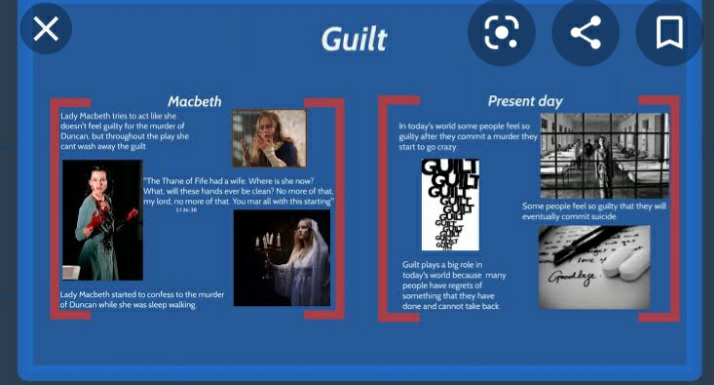
                          That is a very simple view of it, and one can, of course, see it that way if one would like to: the story is gripping, and that’s what it seems to tell us. But what about Lady Macbeth? Macbeth’s basic decency, his nature, full of ‘the milk of human kindness,’ stalls him, as his rational thinking, with all its implications, almost stops him. However, Lady Macbeth, using all the tactics at her disposal – her sexuality, emotional blackmail, flattery – ensures that he carries out the murder. So where does ambition lie in this play? With him, with her, or with both? Perhaps both, but they are two different models of ambition.

5. Learning lesson:-

                       In addition to the points made above regarding ambition, Macbeth also teaches readers that we must have patience and allow the natural order of the world to bring good tidings.  Early in the play, the witches tell Macbeth that one day he will be King of Scotland, but they never suggest how this will happen.  Macbeth's ambition goes unchecked/uncontrolled because he is not patient enough to let things take their natural course.  It is entirely possible that King Duncan (and his sons) may have died the following year from some other cause...
 
6. Play relevant :-

                           One of the ways in which we can relate plays to life today is by examing the character of Macbeth. He has a number of flaws and is easily manipulated, and, even in the 21st century, we can learn from his mistakes. After he first speakes with the weird sisters and after he learns that he's been made Thane of Cowdar, he comes to believe, whole heatedly, in everything they tell him.
                          Macbeth's themes of corruption and ambition remain very relevant no matter the time or place. Throughout history and in modern world, people have used violence and underhanded means to procure power for theme-selves, and often once this power is gained, they are paranoid about loosing it.

2,394 words 14,540 characters


Wednesday, 9 December 2020

Metaphysical Poetry

Expect lecture on metaphysical poetry by Dr. R. K. Mandaliya   sir

          The guest lecture was organised on the topic Metaphysical Poetry and Dr. R K Mandalia sir was invited as the guest lecturer. Dr. R. K. Mandalia is the Head of the English department of Sardar Patel University in Anand. Dr. Dilip Barad, the head of English department of M.K. Bhavnagar University, invites him every year for better understanding of the topic. As part of the syllabus, there are five metaphysical poems, all written by John Donne. Mandalia sir has teaching deep knowledge of this metaphysical poetry and students also enjoy every moment of lecture. Teaching English poetry is not easy but mandaliya sir was a brilliant that he taught us very deeply with singing and we all are enjoying his all session.
  
Metaphysical Poetry:-
          
            
            The word 'meta' means 'after,' so the literal translation of 'metaphysical' is 'after the physical.' Basically, metaphysics deals with questions that can't be explained by science. It questions the nature of reality in a philosophical way.


Characteristics of the Metaphysical poetry:

 (1) Metaphysical Poetry is a blend of passion and thought:


        T.S. Elliot thinks that “passionate thinking” is the chief mark of metaphysical poetry. There is an intellectual analysis of emotion in Donne’s Poetry. Though every lyric arises out of some emotional situation, the emotion is not merely expressed, rather it is analyzed. Donne’s poem “A Valediction: Forbidding Mourning” proves that lovers need not mourn at parting. For instance,


“So let us melt, and make no noise,

No tear-floods, nor sigh-tempests move,

‘There profanation of our joys

Total the laity our love”.


(2)Metaphysical Poetry is a fusion of passionate feeling and logical arguments:


For example, in “The Canonization”, there is passion expressed through beautiful metaphors:


“Call us what you will, 

we are made such by love;

Call her one, me another fly,

We are tapers too, and at our own cost die,

And we in us, find the eagle and the dove”.


But at the same time, the tone of the poem is intellectual and there is plenty of complexity involved in the conceits and allusions, such as the “Phoenix riddle”.

(3) Wit :-


            Critics find two reasons for their desire to differ from the former poets. The first reason is that they were fully aware of the fact that they would have been rejected had they continued writing poetry in the same way. The invention of the printing press helped  a lot in the expanding education and literacy. All the Metaphysical were literate and degree holders. They wanted to exhibit their learning and scholarship. And so they tried to differ from the former poets. 


(4) Metaphysical Poetry is the mixture of sensual and spiritual experience: 


         This characteristic especially appears in Donne’s poetry. Poems such as “The Canonization”, “The Extasie” – even though they are not explicitly discussed, the great metaphysical question is the relation between the spirit and the senses. Often Donne speaks of the soul and of spiritual love. “The Extasie” speaks of the souls of the lovers which come out of their bodies negotiate with one another. For instance,


“And whilst our souls negotiate there,

We like sepulchral statues lay;

All day, the same our postures were,

And we said nothing, all the day”.


(5) Far fetched images :-


           Far Fetched images is one more feature of the Metaphysical poetry. They never tried to use and express their images from that field with which the theme of their poetry was concerned. They tried to bring their images from those fields which have nothing to do with the theme of their poems. So, they are called Far Fetched images. They tried to bring their images from the branches and areas just like, Agriculture Mechanical engineering, Architecture, Biology, Geometry and many other fields.


(6) Usage of satire and irony:


       This is another characteristic of metaphysical poetry. Donne also uses this in his poems. For example, in “The Canonization”, there is subtle irony as he speaks of the favored pursuits of people – the lust for wealth and favors,


“Take you a course, get you a place,

Observe his honor, or his Grace”.

Metaphysical Poems :- 

1. John Donne's Death Be Not Proud, 
2. Flea, 
3. The Sun Rising; 
4. George Herbert's 'The Collar'; 
5. Marvell's 'To His Coy Mistress'

1.The sun Rising :-
           

           The Sun Rising" also known as "The Sun Rising" is a thirty line poem with three stanzas published in 1633 by poet John Donne. The meter is irregular, ranging from two to six stresses per line in no fixed patter. Donne's poems were known to be metaphysical with jagged rhythms, dramatic monologues, playful intelligence, and startling images. The poem personifies the sun. It is addressed to the Sun by a lover who is in the company of his beloved. The lover expresses his concerned for his beloved by addressing this poem to the rising Sun. The present poem is also a good example of Metaphysical poetry. The poem opens with the lover's rebuke to the rising Sun. The rising Sun peeps into the bedroom of this lovers through windows and curtains. The lover doesn't like it. He wants to convince the Sun that the season and climate of lovers can not be governed by the Sun.
  
2.To His Coy Mistress :-

          “To His Coy Mistress” is a metaphysical poem in which the speaker attempts to persuade his resistant lover that they should have sexual intercourse. He explains that if they had all the time in the world, he would have no problem with their relationship moving this slowly.

3. The Collar :-

          George Herbet is also one of the members of the school of Donne, just like Andrew marvell. The title of the collection of George Herbert poetry is 'The Temple'. He wrote his poems to serve Christianity and "The Collar" is an example of it.

       The poem is addressed by a sinner and two selves of that sinner are at war with each other. The poem sounds like a monologue as the sinners speaks on behalf of his desire to live life freely. The word 'Collar' stands for a yoke. So far the yoke of the sinner was bent towards the life of material pleasures. But now it is shifting towards Christianity. The sinner has come across board - an alter and that is enough to inspire him to leave the life of material pleasure.

Reminding the first speaker that there is an end to sadness in sight. If only the speaker will “leave [his] cold dispute” and stop his rebellion, he will be able to open his eyes and see the truth. He second inner voice reveals that, even in the midst of raving, he heard someone calling “Child” and replied “My Lord.” 

1,124 words 6,639 characters

Monday, 30 November 2020

post-truth word of the year 2016


Oxford Dictionaries has declared "post-truth" as its 2016 international word of the year, reflecting what it called a "highly-charged" political 12 months.

It is defined as an adjective relating to circumstances in which objective facts are less influential in shaping public opinion than emotional appeals.

Its selection follows June's Brexit vote and the US presidential election.

Oxford Dictionaries' Casper Grathwohl said post-truth could become "one of the defining words of our time".

Post-truth, which has become associated with the phrase "post-truth politics", was chosen ahead of other political terms, including "Brexiteer" and "alt-right" from a shortlist selected to reflect the social, cultural, political, economic and technological trends and events of the year.


Post-truth : Here are some fakes we debunked earlier

  • Denzel Washington did not praise Donald Trump
  • How to spot a fake US election claim
  • No, this video is not live from the ISS
  • And this one wasn't live , either

Here such example of post truth :

'Spasms of history'

Dr Claire Hardaker, lecturer in forensic linguistics at Lancaster University, said "freak moments" that get people talking were key to the creation of new words.

"When you look back at the dictionary, you get some words that are a spasm of history and they very quickly fall out of use," she said. "They are fashionable, they are trendy and they die.

"Others live on and become part of our language. But it is very unpredictable."


The 2016 shortlist

Adulting :
The practice of behaving in a way characteristic of a responsible adult, especially the accomplishment of mundane but necessary tasks
Alt-right :
An ideological grouping associated with extreme conservative or reactionary viewpoints, characterized by a rejection of mainstream politics and by the use of online media to disseminate deliberately controversial content
Brexiteer :
A person who is in favour of the UK withdrawing from the European Union
Chatbot :
 A computer program designed to simulate conversation with human users, especially over the internet
Coulrophobia - Extreme or irrational fear of clowns
Glass cliff :
 Used with reference to a situation in which a woman or member of a minority group ascends to a leadership position in challenging circumstances where the risk of failure is high
Hygge : A quality of cosiness and comfortable conviviality that engenders a feeling of contentment or well-being, regarded as a defining characteristic of Danish culture
Latinx : A person of Latin American origin or descent, used as a gender-neutral or non-binary alternative to Latino or Latina
Woke : Originally in African-American usage meaning alert to injustice in society, especially racism

428 words 2,748 characters

Sunday, 22 November 2020

SR : Postcolonialism - By Bill Ashcroft

Postcolonialism:-

           The Colonialism is the policy of a country seeking to extend or retain its authority over other people or territories, generally with the aim of  economic dominance. In the process of colonisation, colonisers may impose their religion, language, economics, and indigenous peoples. The foreign administrators rule the territory in pursuit of their interests, seeking to benefit from the colonised region's people and resources.


                     Colonialism is a relationship between an indigenous majority and a minority of foreign invaders. The fundamental decisions affecting the lives of the colonised people are made and implemented by the colonial rulers in pursuit of interests that are often defined in a distant metropolis. Rejecting cultural compromises with the colonised population, the colonisers are convinced of their own superiority and their ordained mandate to rule.

 Summary:-  

              "One of the most exiting features of  English literature today is the explosion of post-colonial literatures written in English in formerly colonised societies. This field has given rise to a great range of theoretical ideas, concepts, problems and debates, and these have been addressed in a great range of articles, essays, talks and books published or written from every continent. This book brings together a selection of these theoretical issues in a way that indicates and celebrates the immense diversity of post-colonial theory. As such it will be an indispensable volume for students, teachers, researchers and theorists, and anybody interested in field." "The uniqueness of this volume is in its range and comprehensiveness. By bringing together nearly ninety extracts from over fifty different writers, it demonstrates the vast spread of post-colonial theory, the degree to which such theory is emerging outside the metropolitan intellectual centres, and the significance such theory has in the practical political issues of living in this range of societies. This book makes accessible the full range of post-colonial theory, which otherwise would be either difficult or impossible for students, teachers or researchers to fully utilize." 

  Critical note:- 

               Postcolonial criticism is an examination is an examination of the history, culture, and especially literature of cultures of Africa, Asia (including the indian subcontinent), the caribbean islands, and south America as they are produced by people from these areas during the colonial era of the nineteenth and twentieth centuries. Specifically, postcolonial criticism is an analysis of the power and political structures that pervaded the relationship between colonial powers and colonized areas in the nineteenth and twentieth centuries. With the development of trade routes under the Ottoman Empire,

                          Gujrati Hindus, Syrian 

                   Muslims, Jews, Armenians, 

                  Christians from south and 

                  central Europe operated 

                  trading routes that supplied

                  Persian and Arab horses to

                  the armies of all three 

                  empires, Morcha coffee to 

                 Delhi and Belgrade, persian

                 silk to India and Istanbul.


Thursday, 19 November 2020

Devang Nanavati : 'Talk on Eco critical thinking'

Sitanshu yashschandra's "Trees once Again"
  
      
                 Sitanshu Yashaschandra Mehta (born 1941), better known as Sitanshu Yashaschandra, is a Gujarati language poet, playwright, translator and academic from India.


       He is the President of Gujarati Sahitya Parishad. He was awarded the Sahitya Akademi Award for Gujarati given by Sahitya Akademi, India's National Academy of Letters, writer in 1987 for his poetry collection Jatayu. Subsequently, he was awarded the Padma Shri, the fourth highest civilian award by Government of India, in 2006. 
       

       Trees are vital. As the biggest plants on the planet, they give us oxygen, store carbon, stabilise the soil and give life to the world's wildlife. They also provide us with the materials for tools and shelter. That is the reason sitanshu write about the tree that we understand the situation of trees..And also  explain the importance of trees.  

About Eco criticism:-
        
         Eco criticism gives importance to the relationship between human beings and nature, how are human beings affecting nature and vice versa. ... In a broader perspective, Ecocriticism guides us to examine the world around us and critiquing the mannerisms of society in the treatment of nature. 
        Ecocriticism is the study of literature and environment from an interdisciplinary point of view where all sciences come together to analyze the environment and brainstorm possible solutions for the correction of the contemporary environmental situation.
       It is literary "criticism that arises from and is oriented toward a. concern with human and nonhuman interaction and interrelationship." Ecology has two shades, the shallow, and the deep ecology. Ecocriticism is the study of literature and environment from an interdisciplinary point of view where all sciences come together to analyze the environment and brainstorm possible solutions for the correction of the contemporary environmental situation.
         Today we can’t understand the importance of the nature and we use all the things of nature for our profit, and that the result it can damage our environment. We can’t understand that one day it becomes harmful to us. And than we don’t suppose that what to do??? And how to do???
        We can see this video link and also think that about the situation of our after 10 years..

Link:-   
  

Chipko movement:-
          
         
         The Chipko movement was a non-violent agitation in 1973 that was aimed at protection and conservation of trees, but, perhaps, it is best remembered for the collective mobilisation of women for the cause of preserving forests, which also brought about a change in attitude regarding their own status in society. The uprising against the felling of trees and maintaining the ecological balance originated in Uttar Pradesh’s Chamoli district (now Uttarakhand) in 1973 and in no time spilled onto other states in north India. The name of the movement ‘chipko’ comes from the word ’embrace’, as the villagers hugged the trees and encirled them to prevent being hacked.
          
        Environment is the most important aspect to survive on this planet. Humans tend to forget that without a balanced environment, life cannot be sustained. With climate change upon us, sea levels on the rise, and increasing numbers of earthquakes, floods, and droughts, we cannot stress this enough.

Tuesday, 3 November 2020

Thinking Activity


The Renaissance period

         The literary term 'Renaissance' refers to the rebirth of learning that began in Italy in the fourteenth century that spread to the month, including England, by the sixteenth century, and ended in the mid-seventeenth century" The term 'Renaissance' is generally applied to the historical period which follows the Middle ages. It has been a metter of much debates that when the Renaissance began...

The term 'Renaissance' refers to the rebirth of classical Greek learning 'Renaissance' has been described as the birth of the modern world out of the ashes of the dark ages. Renaissance means "the discovery of the world and the discovery of the man." Before it there was an image of Middle ages as being ignorant, narrow, priestridden, backward, superstitious, and uncultured. On the other hand, the Renaissance was praised highly as being learned, civilized, broad-minded, progressive, and open-minded. 

▶️ Ben Jonson : (1573-1637)
           
          Ben Jonson was born in 1573, possibly, a month after the death of his father. He was married in 1594, to Anne Lewis. Unfortunately he lost a daughter at six months and a son at the age of seven month. In 1597, he was imprisoned for his share in Nashe's seditious satire, The isle of Dogs, and again in 1598 he killed a fellow actor in a duel and he could save himself from hanging only by pleading the benefit of clergy.

        Ben Jonson's first comedy was Every Man in His Humour. This is a realistic comedy of london life. It express the life of young gallants of london life. It expresses the life of young gallants of london satirically. In this comedy, Ben Jonson created the fine characters of Bobadil and kitely. Every Man in His Humour at once made Ben Jonson the idol of the literary world. His second comedy, Every Man out of his Humour was the first time Ben Jonson laid down his intention of being a satirist in drama. The other comedies cynthia's Reveals and postmaster Were acted in 1600. Both this comedies are satirical in tone. In this next play Sejanus. Both these comedies carried his theories of art into tragedy.

In 1605 Ben Jonson produced his great masterpiece volopne. This comedy achieved a victory both in London theatres and in the two universities. All his comedies are rich in details and are taken from life of actual manners. The last years of Ben jonson's life were full of suffering and sorrows. He died in 1637 and was buried in Westminster Abbey. On his tomb are inscribed the word " O rare Ben Jonson." 

यूनिट-२ : पठन और कथन कौशल्य आधारित प्रवृत्तियां |

यूनिट-२(२.१) हिंदी साहित्यि के दो उत्तम काव्य का पठन करें । हिंदी देश के निवासी हिंदी देश के निवासी सभी जन एक हम, रंग रूप वेश भा...